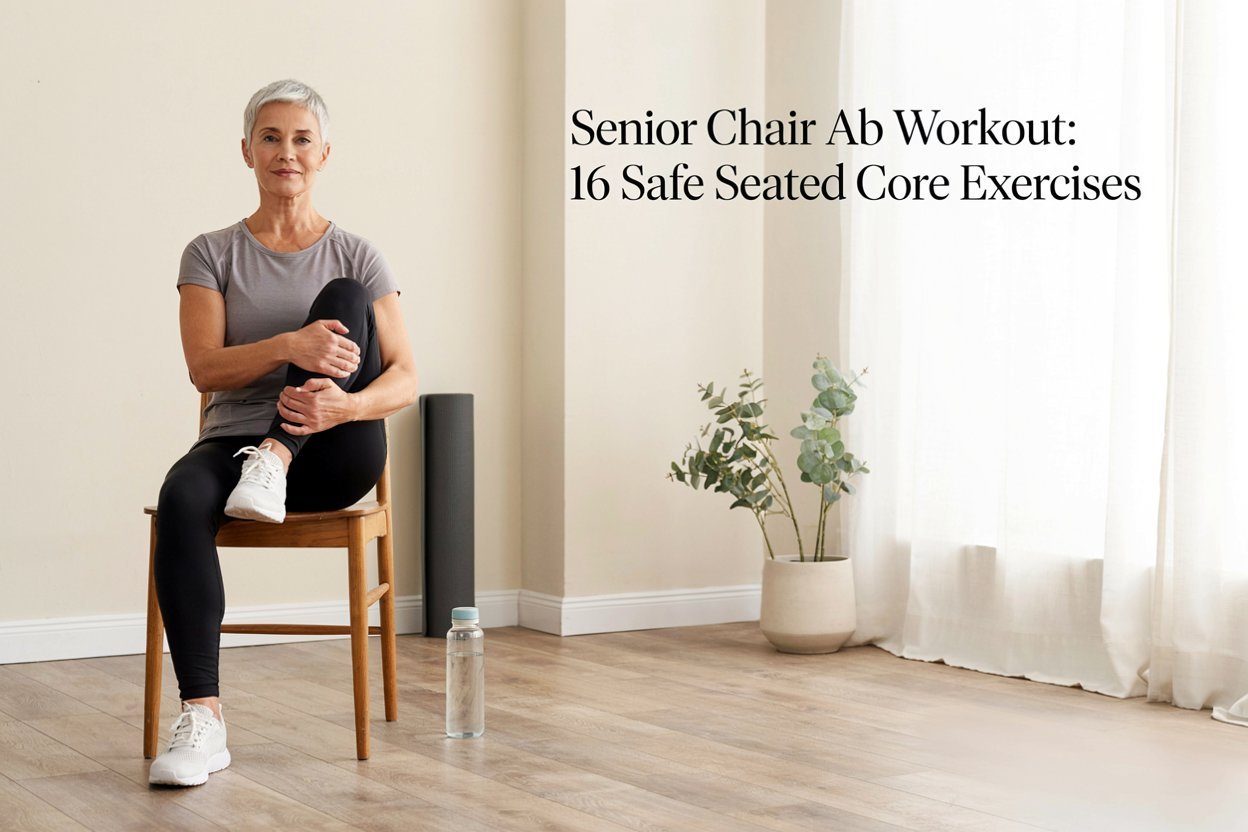
A sturdy chair turns out to be one of the most underrated pieces of fitness equipment there is, especially for building core strength safely as balance, joint comfort, or mobility change with age.
This routine uses nothing but a chair and body weight, and every movement is designed to keep at least one point of contact with the seat or backrest at all times, which takes fall risk almost entirely out of the equation compared to floor-based ab work.
Core strength matters more than most people realize for everyday movement, getting up from a chair, reaching for something on a shelf, maintaining good posture, and reducing lower back strain.
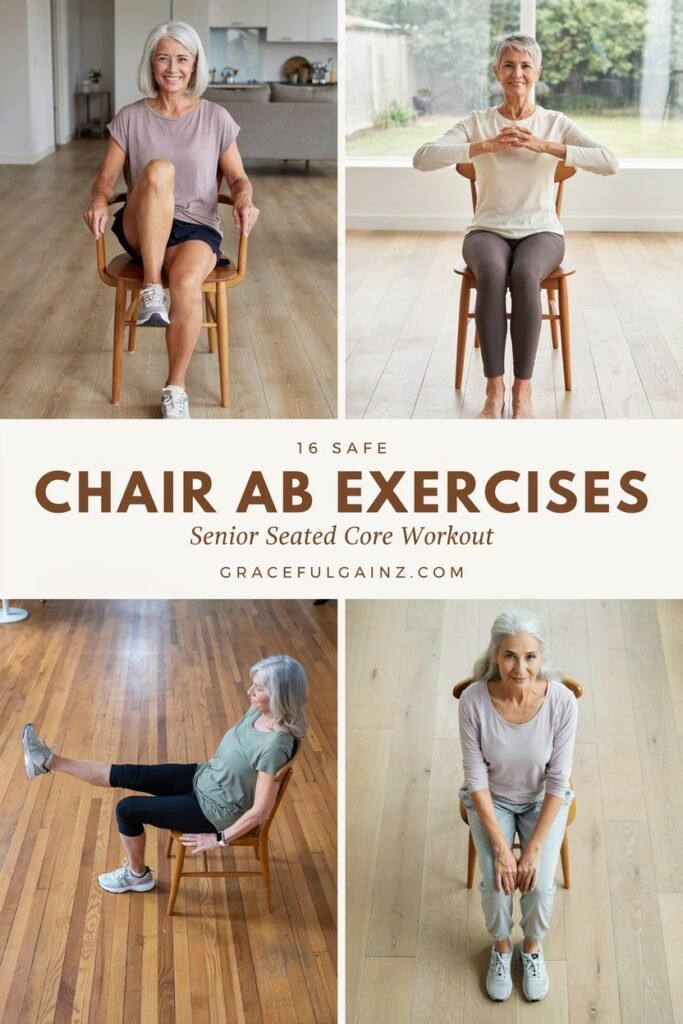
This routine works through the same core muscles a floor-based ab workout would target, just in a seated position that’s accessible regardless of current fitness level.
A quick safety note before starting: check with a doctor before beginning any new exercise routine, especially if you have a heart condition, osteoporosis, recent surgery, or balance concerns.
Use a sturdy, armless chair without wheels, placed on a non-slip surface. Stop immediately and rest if you feel dizzy, short of breath, or experience any pain beyond normal muscle effort, and never hold your breath during any of these movements, steady breathing throughout is part of what keeps this safe.
Why Chair-Based Core Work Is Effective

It removes fall risk almost entirely. Since you remain seated with a stable base throughout, this eliminates the balance demands that make floor-based core exercises intimidating or risky for many older adults.
It still effectively targets the core. Many of these movements engage the same abdominal, oblique, and hip flexor muscles as traditional floor exercises, the seated position changes the risk profile, not the muscles being worked.
It’s accessible regardless of current fitness level. Every exercise below can be scaled by reducing range of motion, reps, or speed, so this works as a starting point for someone returning to exercise after time off, and can still be challenging for someone more active.
The 16 Exercises
1. Knee Lifts

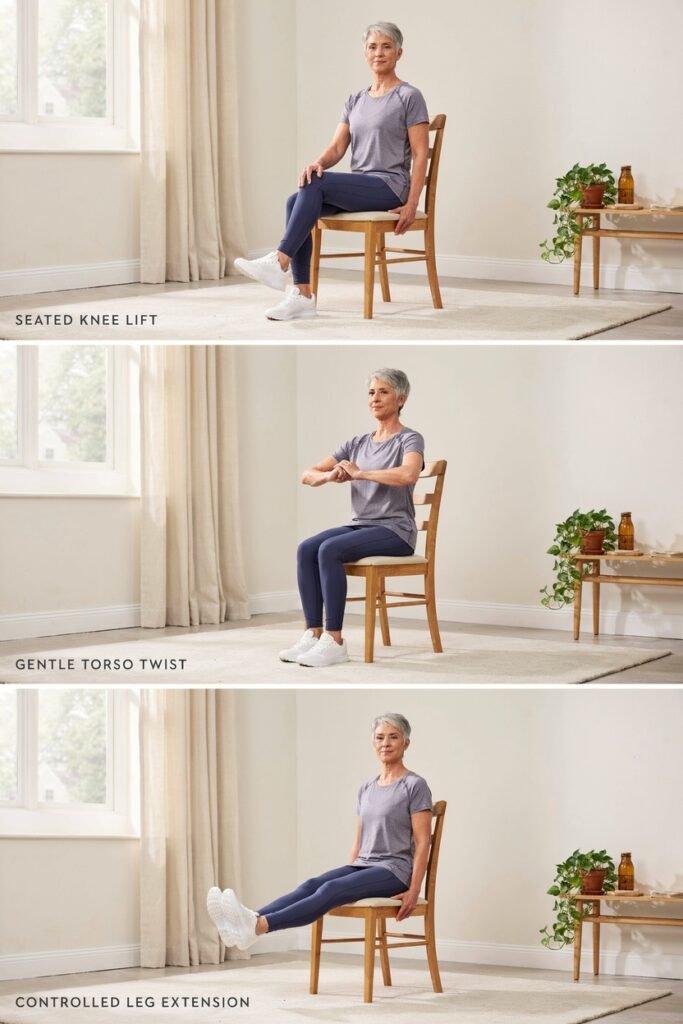
Sit tall with your back against the chair. Lift one knee toward your chest, then lower with control. Alternate legs for 10 to 12 reps on each side.
Keep your core gently engaged throughout rather than gripping the chair seat for momentum.
2. Marching

Sitting tall, lift your knees alternately in a marching motion, keeping a steady, controlled pace rather than rushing.
Continue for 20 to 30 seconds. This one also works well as a gentle warm-up before the rest of the routine.
3. Torso Twists

Sit with your feet flat on the floor and arms crossed loosely over your chest, or hands lightly touching your shoulders.
Twist your upper body to one side, then the other, moving through your midsection rather than yanking with your arms. Aim for 10 reps each way, keeping the movement controlled rather than fast.
4. Side Bends

Sit tall with one arm raised overhead. Lean gently to the opposite side, feeling a stretch and contraction along your side body, then return to center.
Do 10 reps on each side, keeping your hips grounded in the chair throughout.
5. Leg Extensions

Sit tall and extend one leg straight out in front of you, hold briefly, then lower with control. Complete 10 reps per leg.
Hold the chair seat lightly with your hands if you want extra stability while your leg is extended.
6. Knee-to-Elbow

Sit tall and bring one knee up while rotating your torso slightly to touch it toward the opposite elbow, then return to start. Complete 8 to 10 reps per side. Move slowly here, this is more about controlled rotation than speed.
7. Pelvic Tilts
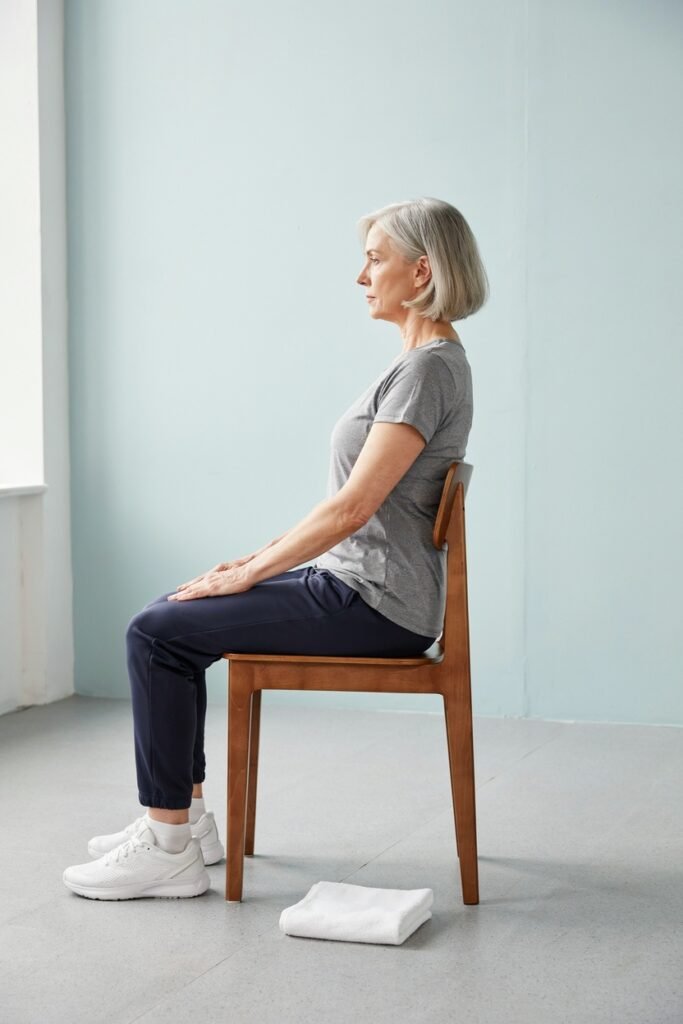
Sit tall with feet flat on the floor. Gently tilt your pelvis forward, then backward, feeling the movement through your lower abdominals and lower back. Complete 10 to 12 reps.
This is a subtle movement, and that’s genuinely the point, it’s meant to isolate deep core engagement rather than look dramatic.
8. Heel Taps
Sit tall and alternately tap your heels on the floor in front of you, keeping your core lightly engaged throughout. Continue for 20 seconds. Keep the movement light and controlled rather than stomping.
9. Forward Reach
Sit tall, then hinge forward from your hips, reaching both hands toward your toes or shins, whichever is comfortable, then return upright with control.
Complete 8 to 10 reps. Only reach as far as feels comfortable, this shouldn’t cause any strain in your lower back.
10. Leg Circles
Extend one leg out in front of you and draw small, controlled circles in the air, 5 to 6 circles each direction, then switch legs.
Keep the circles small rather than large, which keeps the movement controlled and reduces strain.
11. Side Leg Lifts

Sit tall and lift one leg out to the side, keeping it relatively straight, then lower with control. Complete 8 reps per leg. Hold the chair seat with one or both hands for extra stability during this movement.
12. Arm and Leg Reach
Sit tall and extend one arm forward while extending the opposite leg out to the side or front, holding briefly before returning to start.
Complete 6 to 8 reps per side. This one challenges coordination as well as core stability, so take it slowly at first.
13. Slow Bicycles
Sit tall toward the front of the chair with a bit of back support if needed, and pedal your legs slowly in a cycling motion, as if riding a bike at a gentle pace.
Continue for 20 to 30 seconds. Keep the motion slow and controlled rather than fast, speed isn’t the goal here.
14. Oblique Crunch
Sit tall and bend to one side, bringing your elbow down toward your hip on the same side while gently contracting your obliques.
Complete 10 reps per side, moving with control rather than momentum.
15. Tummy Tightening
Sit tall and simply contract your abdominal muscles inward, as though gently bracing for a light tap to the stomach, holding for about 5 seconds before releasing. Repeat several times.
This is a subtle, isometric movement that’s easy to underestimate, but it’s genuinely effective for deep core activation.
16. Cross Kicks
Sit tall and extend your legs forward, crossing one over the other alternately in a scissor-like motion. Complete 10 reps each side, keeping the movement controlled and your core lightly braced throughout.
Modifications for Different Ability Levels
If balance is a concern for any standing transition in or out of the chair, have a second sturdy piece of furniture or a wall within reach, or have someone nearby for the first few sessions until you’re confident in the routine.
If a movement causes any joint discomfort, reduce the range of motion rather than skipping the exercise entirely. A smaller, pain-free version of a movement still provides benefit.
If you’re returning to exercise after a long break or recovery period, start with fewer reps than listed, and fewer total exercises in a single session, building up gradually over several weeks rather than attempting the full routine on day one.
If you use a wheelchair regularly, many of these movements, particularly torso twists, side bends, pelvic tilts, and tummy tightening, can be adapted to a wheelchair with proper brakes engaged, though check with a physical or occupational therapist for guidance specific to your equipment and needs.
Tips for Getting the Most Out of This Routine
- Use a chair without wheels, with a stable, flat seat. An office chair or anything with wheels or a cushioned, unstable seat isn’t appropriate for this routine.
- Keep your feet flat on the floor for most exercises, adjusting your seated position rather than perching on the edge unless a specific exercise calls for it.
- Breathe steadily throughout every movement. Holding your breath during effort is a common habit but can affect blood pressure, so keep your breath moving continuously.
- Quality over speed, always. A slower, more controlled repetition is more effective and safer than a fast, sloppy one.
- Build up gradually. You don’t need to do all 16 exercises in one sitting, especially when starting out. Splitting them into two shorter sessions is a completely reasonable approach.
Who Should Check With a Doctor First
- Anyone with a diagnosed heart condition or high blood pressure that isn’t well controlled.
- Anyone recovering from recent surgery, particularly abdominal or back surgery.
- Anyone with osteoporosis or a history of compression fractures, particularly regarding the forward reach and torso twist movements.
- Anyone experiencing dizziness, vertigo, or balance issues on a regular basis.
- Anyone new to exercise entirely after a long period of inactivity.
Frequently Asked Questions
How often should this routine be done? Many people do well with 3 to 4 sessions per week, allowing rest days between sessions, though this should be adjusted based on individual comfort and any guidance from a healthcare provider.
Do I need any equipment besides a chair? No, this entire routine is designed to be equipment-free beyond a sturdy, stable chair.
How long does the full routine take? Doing all 16 exercises with the listed reps and timing takes roughly 15 to 20 minutes, though it can be split into shorter sessions if needed.
Is this routine appropriate for someone who has never exercised before? Yes, this is specifically designed to be an accessible starting point, though starting with fewer exercises and lower rep counts is a reasonable way to ease in.
Will this routine help with everyday activities like standing up from a chair? Core strength genuinely supports these kinds of functional movements, since a stronger core improves stability and control during transitions like standing, bending, and reaching.
Final Thoughts
This routine proves that effective core work doesn’t require getting down on the floor or using any special equipment, just a stable chair and consistent, controlled movement.
Start with whatever feels manageable, build gradually, and remember that consistency over time matters far more than pushing hard in any single session.